Showing posts with label 3D print. Show all posts

Saturday, December 03, 2022

Saturday Film Club: Building the Worlds Smallest Escalator (That WORKS)

An interesting 3D print and laser cutting project that shows there is a lot more to doing things that just owning the tools. 

Most of the parts went through several itterations before a final version appeared. That might be easier if you just have to tweak stuff on a screen and re-print/cut, but it demostrates that there's still a lot of skill involved, just different skills to "traditional" modelling.

Sunday, September 29, 2019

TCT 2019

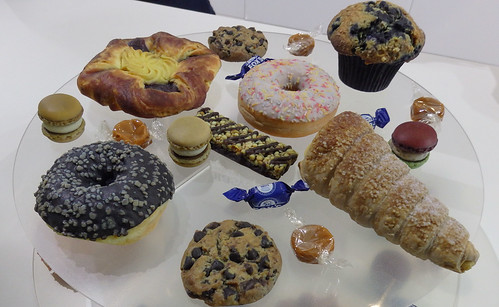
3D printed cakes

These cakes are rubbish.

Because they are 3D printed and therefore inedible!

To be fair, the printer that does it is an amazing bit of kit. Mind you, for £225,000 it ought to be. You could buy all the stock in a Greggs for that and it would taste better. 

On Wednesday, I headed to the NEC for the annual TCT 3D printing show. While a sceptic, I'm interested enough to keep abreast of the technology. Maybe it's out of my reach for the moment, but things change over time. 


Tuesday, February 05, 2019

#3dBenchy

If you've read the March 2019 issue of BRM, you'll have spotted that I have borrowed a 3D printer to play around with.

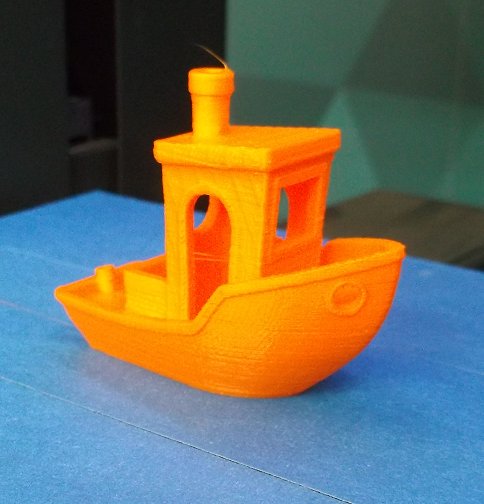
While I am doing some proper model railway type jobs, I couldn't resist using some spare filament to satisfy my desire for the little cartoon boat model spotted everywhere at a 3D print show.

I had wondered why it was so common on every stand but quickly discovered the boat is #3DBenchy - a freely available model for testing and comparing printers. You can download the data from the official #3DBenchy website

Of course, I did this, then re-sized it to 4cm long as I didn't want to use too much lovely orange PLA. I fired up the printer and off it went.

A couple of hours later, the result wasn't quite what I expected. There's an awful lot of support material required for the model. Breaking this away is a bit fiddly and time-consuming, but with a bit of brute force and ignorance with small pairs of pliers, a little model appeared.

 I love the design of this little model. The thing is, I'd always wondered if it were possible to build it big enough to sail. It seems I'm not the first person to think this and there is a design for radio-control on the Thingiverse. There's also a load of 3DBenchy variations. I think I'm going to need some more filament...

Friday, May 29, 2015

Little Phil puts on his specs

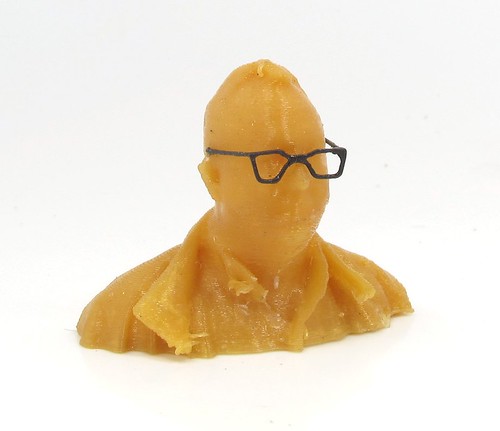
Little Phil wearing glasses

One thing that "Little Phil", the 3cm tall 3D printed model of me was missing, was a pair of glasses.

I've worn 'specs since I was 10 but it seems that 3D scanners struggle with glasses , so like a passport photo, you have to take them off.

Fine, but then it doesn't really look much like me, so yesterday, I spent a few minutes with some 0.33mm brass wire and a soldering iron, making a pair.

It's much harder then it looks to do this. The end result is a bit more rock star (anyone who said Dame Edna Everage can leave now) than I'd like but they will do for the moment.

Incidentally, if you want your own Little Phil, you can download the model:


If you want to know more about the scanner used to do this, it was the Structure scanner in combination with the ItSeez3D app for iPad. And I want one.

Thursday, May 28, 2015

#3dBenchy

3dBenchy3

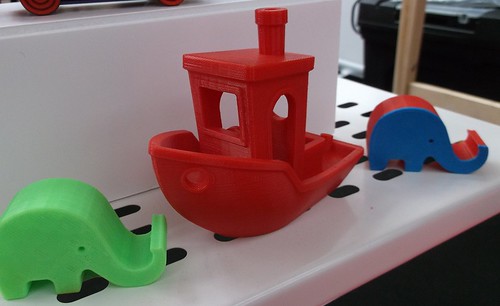
Wandering around the 3D Print show, I spotted a little orange boat. Being a bit of a boat fan, I took a closer look. I liked the cartoony style - it had a definite "cute" about it.

Then I saw another one on a different stand.

3dBenchy2

and another

3dBenchy1

What was happening? Was it an invasion? Was the Spanish Armada back in miniature form?

The answer came in the far corner of the show.

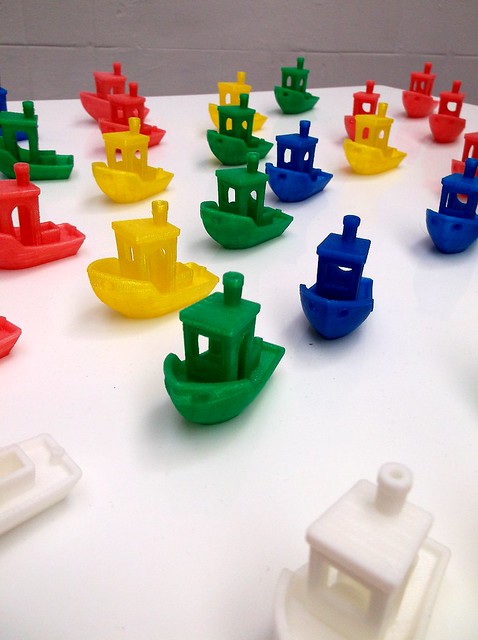
3dBenchyflotila

The model is #3DBenchy, a design that has been made freely available for people to download and print. The idea is that you have the design as a control file which can be sent to different printers. The designers provide dimensions so the printer can be checked and calibrated.

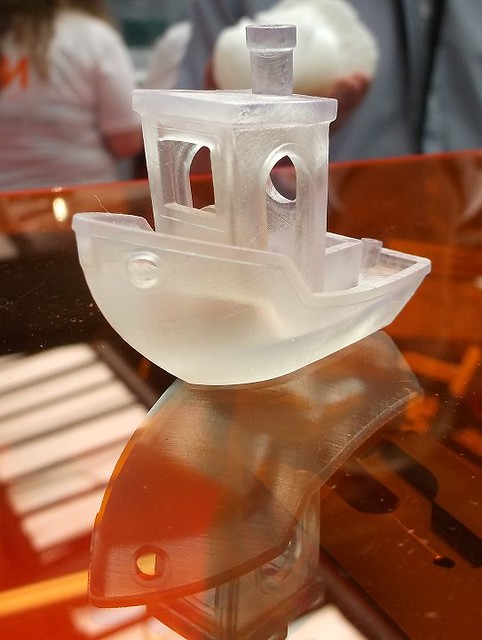
Different printers can be compared against each other too. The stereo lithography clear print above looks better than any of the others for example.

Of course, I wonder if I could print one off big enough, would it float and could I stick a motor in it?

More details at the 3D Benchy website.

Wednesday, May 27, 2015

Hopefully, THIS video works


Apparently yesterday's video showing 3D printing didn't work for some people. Sorry about that.

The problem was that I had put the film on Flickr, and they recently "upgraded" their service so that it doesn't work in Internet Explorer 9 - the web browser I use and can't upgrade until I get to a version of Windows beyond Vista.

Since I have a Windows 8 laptop, and consider this operating system to be the greatest advert in favour of software piracy (they are stealing mine and lots of peoples time with this stupid, unusable software, we should be able to raid Microsoft's HQ and steal all their stationery for a start), I'm waiting for Windows 10.

The workaround is to use Firefox as my browser, but even here, Flickr's "improvements" get in the way and you can't easily share video, at least not without it breaking it seems.

Uploaded to YouTube, the video now works (I hope) and you can enjoy it above. Of course, this also required Firefox (Or Google Chrome, which is also evil) so that's taken me rather longer than it should.

And people say building kits is hard work...

Tuesday, May 26, 2015

Video: 3D printing


I mentioned yesterday, that I was filming 3D printers in action when I was leapt upon and scanned.

Even though I've seen the process many times, I still find it mesmerising - hopefully you do too, as here's the results of the filming.

Monday, May 25, 2015

3D printed "little" Phil

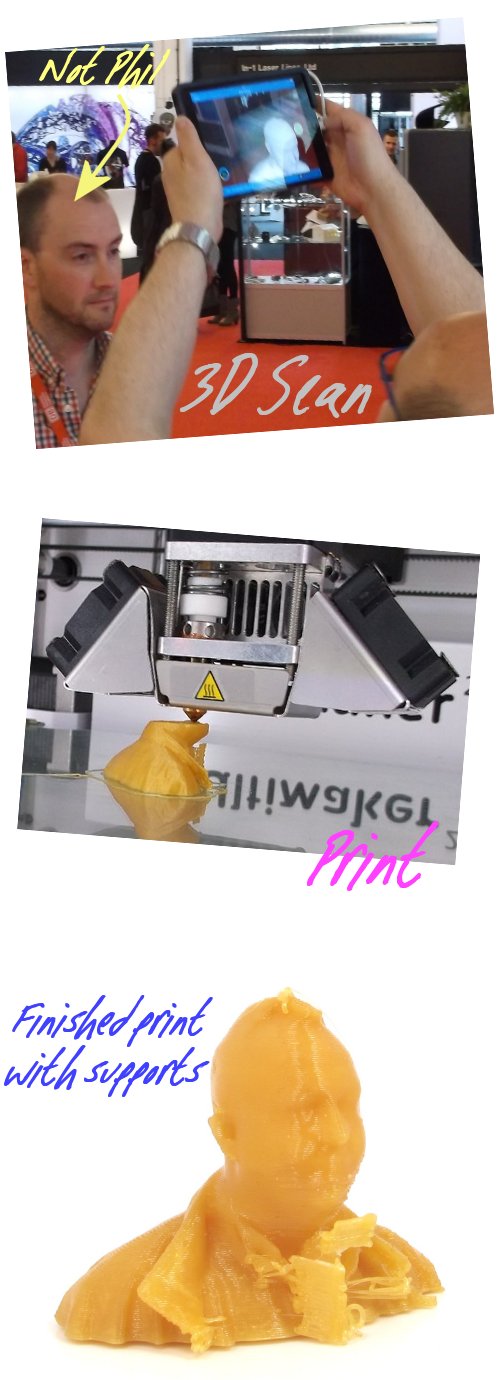
Lat week, I visited the London 3D print show. Waiting around for my colleagues to join me, I filmed a printer producing little head and shoulder models of visitors. While doing this, I was leapt on by one of the stand staff and offered the chance to be immortalised in PLA.

How could I resist?

Making little phil

To support the chin and front of head, sacrificial supports are printed into the model. These can be trimmed off with sharp knife, revealing the finished article:

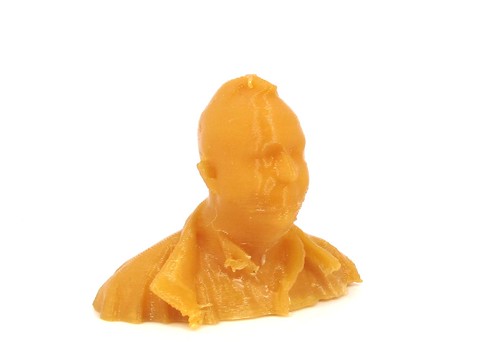
Little Phil

Not too bad a likeness, at least as good as you get in 3cm tall plastic models! Printing time was 40 minutes on an Ultimaker printer.

Tuesday, March 24, 2015

3D printed model boats


George wrote: I know you like your model boats and thought this article would be of interest to you
http://www.3ders.org/articles/20150321-3d-printed-boats-become-a-hit-for-both-adults-and-kids-in-japan.html

Fascinating stuff. The boats have a cartoony element about that that really appeals to me. The article is a bit light on construction details but if you head over the modellers blog (In Japanese but this is the Google translate version) there is more information.

Close up, the models show all the crudeness of modestly priced 3D printing but on the water, you can live with this. There is some clever work with home-printed impellers and miniature outboard motors.

The boats are made up of several components, each printed in the required colour. In this respect the method follows traditional injection moulding, but of course 3D print allows people to try things out without thousands of pounds of tooling costs.

If you want to know more, it's well worth digging through the blog and there is a "warts'n'all" approach with bad prints being shown. I have a feeling that this would be ideal for home based printing kit. If only I had the time/space/money....

Sunday, September 14, 2014

3D Printing show 2014

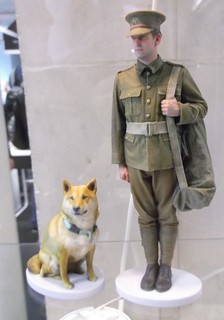
SoldierLast week, I wangled a press pass to the 3D printing show in London. I'm interested in the subject and the event was well worth a visit.

On display were cutting edge print machines churning out both little and big models. From printers you could buy to bureau services, there was a heck of a lot on show. If you don't fancy learning CAD then there were even scanners for things from tabletop ornaments to full sized people.

The big surprise for me was that colour printing is happening. The material has a stone texture finish but in many cases this doesn't matter and the repro is superb.

My take on the technology?

Well, it's good. For prototypes and VERY short production runs, it's brilliant.

BUT. It isn't as good as many people would have you believe, at least for our sort of small scale model making. Look at the surfaces and the texture is sandpaper. Curves display facets from the layers of plastic used to build them up. With these normally being 0.15 to 0.2mm thick, they are visible. And this is the cutting edge technology.

Another aspect often ignored is the time taken for a print. Something the size of a OO loco is going to take 5 hours or more to produce. Better hope the computer doesn't go to sleep in that time too as the results look like a plastic spaghetti explosion. Most printers can accept USB keyfobs and SD cards with the design on to get around this.

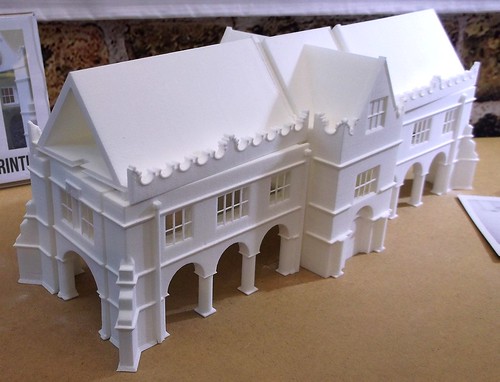
Market Hall

Price is an issue too. A very nice 4mm scale market hall would come in at a bit under £400. I'd probably build you one for that money. The firm concerned are working on clever design to bring this down. By printing it as a kit rather than a finished building they can reduce print time and therefore (apparently) cost.
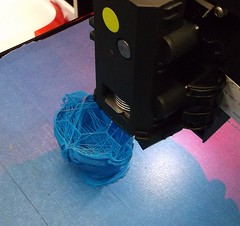
Printing in actionHaving said this, I'm still fascinated by the technology. I am sure that it has a place in the modellers toolkit and that place is going to grow as print layers become thinner or different technology is used, resin printing looks very interesting for example.

When someone tells me there is no need to learn any modelling skills as they can do it all on a computer and print the results, I still think they are wrong. Even where they are right, you've got to climb the steep learning curve with a CAD package and gain experience in making 3D print items as it's not as easy as it looks.

More to the point, I like making things with my hands. If you can print everything, and there was one printer that would tackle a micro-layout sized job, then it's going to be time to find another hobby. But not for a good few years yet I think.

My photos from the 3D print show on Flickr

Tuesday, June 10, 2014

3Doodler 3D pen

3D DoodleThis 3D print stuff fascinates me. I'm impressed with the technology, if not as blind to the current level of development as many of a people on forums who see it as way of never having to do any of that fiddly model making.

One of the never ideas out there is the 3Doodler pen. It's not really the same as 3D printing, even though it's lumped in with the serious kit. That doesn't mean it's of no interest though. I'm always happy to tinker with a gadget with the idea it might have some model making uses.

Hanging around a quiet Maplin on a wet day, I decided to ask if I could have a play. Even though my total purchases were limited to some LEDs and a 9V battery snap, the assistant was happy for me to fire it up and hand it over.

The device is a fat, pen shaped object with two buttons and a fan. Basically, it's a hot glue gun that extrudes a plastic. Plug it in and the fan comes on. After a few seconds, the device is up to temperature and you can press a button to get started. Despite appearing to be forward and reverse, the buttons are just two speeds of extrusion.

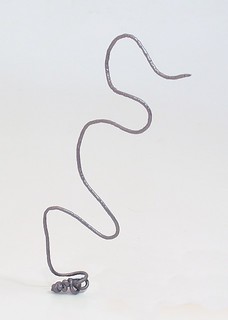
On the advice of the assistant, I started my test by making a mound on the paper to glue my "model" to the surface. Then I drew a wiggly line in the air.

My line is 7.5cm tall and free standing. Working slowly, the plastic hardens fast enough to support itself withing a couple of seconds. The 1mm thick line is surprisingly strong too. My little doodle is springy and not at all brittle. I was impressed.

So, what use is this?

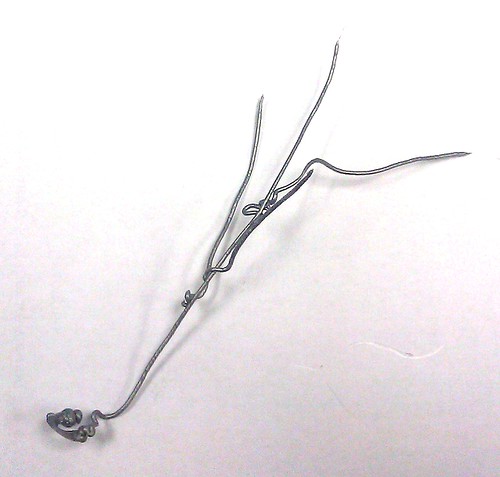
Not sure. Attempt two was a less than successful tree armature. Sticking branches to each other neatly would take practise and I had been using the tool for around 2 minutes. If it can be done, the finished tree will be flexible enough to take knocks but I'm sure strong enough to support fine gauze covered in flock powder. Thickening up the trunk could be carried out by drawing extra lines up it.

3D Doodle2

It's certainly an interesting tool. I didn't stump up the £99 to buy one, although if anyone wants to send one to me for proper testing, I'd be happy to devote more time to it.

With work, I wonder if a finner nozzle could be made to produce telegraph wires. Or rope for bunting. Or rope on boats generally. The plastic isn't elastic so won't stretch but I reckon there is way around this.

Interesting. Great fun to play with too.

Maplin 3Doodler

Sunday, September 23, 2012

A little bit more on 3D printing

This week, 3D printing popped onto my radar again.

First up we have Sad little Keanu Reeves.

From the website, it looks like he is a pretty realistic model figure. The important bit is that he's printed in colour. Realistic colour. The sort of colour you would normally have to apply with a brush.

It's not quite the future - Keanu is "printed" in sandstone rather than plastic. According to the description he's pretty heavy because of this and very fragile. On the other hand, mini Keanu is a less wooden actor than the real thing.

Elsewhere, over at The Register, Simon Rockman and Gary Sheinwald ask "How hard is 3D printing ?" by running through the process to produce a simple logo. If you want to know more, I recommend a read as they talk about the technicalities of using a simple machine. While most of us will send stuff to a bureau, one day we might all have a replicator in the corner of the workshop.

Sunday, August 21, 2011

3D printed 4mm scale K6 telephone box

How's that for a title full of Google juice ?

K6 Box bits

Yes, the final (for the moment) trip into the world of 3D printing has arrived. The man from UPS dropped off a box big enough for a reasonable sized cat or two modest tubs of ice cream. Inside was loads of polystyrene and a small packet containing the parts show above. Methinks that Shapeways boss ought to go down to the packing department and have a quiet word with them.

Anyway, the parts are printed in a soft and flexible material which apparently allows for greater detail than the stuff used before. It certainly works - those glazing bars are incredibly thin. Even injection moulding would be pushed to replicate this. The telephone on the back wall is very nice too, better than the whitemetal ones I've used in the past.

Assembly required simply clipping the sides into the base and then the top on to these. Some glue in the corners is a good idea. One problem is that the material makes the parts very difficult to see and it took me a couple of goes to work out that the door must be opposite the back wall or the corners don't work. It's very flexible too making things a little more tricky.

4mm K6 BoxOnce stuck together, I sprayed the model with Modelmates primer and then several coats of Humbrol satin red. Slightly too many as it turns out as one of the "Telephone" signs is a little flooded. With the paint on I could also see my duff assembly, too late to do anything about it. Let's just hope no-one notices the door is ajar... The surface of the sides isn't flat either but covered with micro furrows in bands. From normal viewing distances the effect is OK by if you look very closely you'd wish you'd used etched brass.

Finally there is a problem that may or may not be connected with the material - the paint won't dry. 18 hours after spraying, it's still tacky.

K6 box on Shapeways website

Sunday, August 07, 2011

3D printing - first results

Printed locoLast week I opined about the future of modelling and wondered if 3D printing was going to make all those boxes of bits we model makers stash away obsolete. Not knowing the real answer I decided to take the plunge and order a couple of examples from Shapeways to see what they were like. The first has arrived.

The first thing is that the service was amazingly swift. I placed my order on Sunday and the box turned up on Wednesday. Not bad considering the contents didn't exist in anything other than a computer file when I requested them.

Anyway, my parcel contained an On30 steeple cab locomotive body that looks a heck of a lot like the one running on my model of the Hellingly Hospital Railway. The material its made in is described as "White, flexible and strong". It's certainly white, seems as flexible as similar thickness plastic and presumably has a similar strength although I've not tested this.

SurfaceThe surprise is the surface. I knew that 3D printers couldn't do curves very effectively, they render as a series of steps albeit tiny ones, but the verticals on this model have the texture of very fine sandpaper. I'm assuming that this is because the model is "grown" from a pile of powder. I'm not sure how to deal with this at the moment. My inclination is to shoot a coat of high-build primer over the whole thing to see if this smooths the surface without losing the lovely rivet detail on the ends.It's this that stops me sanding the model flat, well that and the feeling that I shouldn't need to. After all, if I have to sculpt the model locomotive out of a lump of plastic, this isn't the future. Well not yet anyway.

Never mind, I'm reasonably impressed. I'll see if I can turn this into a finished model. In the meantime, I've also got a K6 telephone box on order in a different material. We'll see how that turns out.

Sunday, July 31, 2011

Farewell to drawers full of bits ?

Yesterday I quickly reviewed some Scalescenes card kits for ISO shipping containers. These are interesting models but it's the delivery mechanism that is revolutionary and I wonder if it is the shape of things to come.

The principle of the kits is that the modeller buys the file along with the rights to produce as many copies for personal use as he or she wants. Production of the model is completely down to the purchaser. In this case that means you print off the kit parts yourself and lamitnate them on to cardboard to produce the components. In a couple of years if I want another kit, I just fire up the computer and printer to make it.

But can we go further ?

3D printing is much discussed on many modelling forums. At present the results aren't high enough quality for those of us in the smaller scales. Each layer of plastic laid down is arount 1/3rd of a millimetre high and to get acceptable results that has to be reduced by a factor of 10. On the other hand, people are experimenting like crazy with the technology:

Train

As you can see from the comparison above, the injection moulded model (Top) has nice smooth curves wheras the 3D printed version shows how the material is applied in layers. This will change though one day. The technology will improve, at which point will we all own our own printers and run off components ?

The machine at the top of the page is from Makerbot industries. It's a 3D printer you can buy off the shelf for around £1500 - less if you are prepared to do some of the assembly yourself. Obviously you then need to feed the machine a CAD file but it's a start.

Logically once you have the device then a Scalescenes style service where you buy the data for the part and run it off yourself is then a real possibility. The files themselves are readily available already and should you want the finished models then these can be bought on-line. Searching the Shapeways web site for the word "Train brings back 18 pages of results. I had a dig through and found a nice looking K6 phone box and a loco body that looks suspiciously like the one for the Hellingly Hospital Railway. Out of curiosity I've ordered these and will let you know how they turn out.

This is the future though. One day we won't store drawers full of components, we'll run them off as we need them. Except that we probably won't even do that, we'll buy in the data and make the model in CAD an then print it out. I'm not sure this sounds nearly as much fun but I suppose you can't stop progress.