£20 well spent?
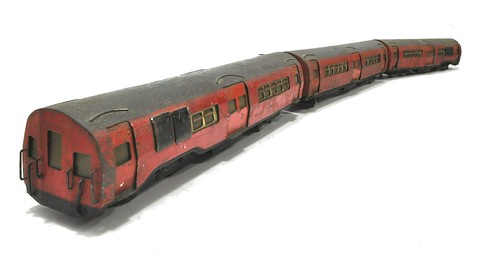
Spotted on a stall at the recent G1 event, I couldn't resist this interesting 3-rail tube train. My first thoughts were that it is scratchbuilt but I couldn't be sure. There are no identifying marks and despite being a similar vintage to the famous Ever-Ready model, it's not that one.

Assuming I'm right about this being scratchbuilt, the modeller was very skilled at producing a press to stamp holes in tinplate as the work is very neat. I like the window-top vents too, made in acetate.

Power comes from a very professional looking bogie.

Trailing bogies are a bit cruder but perfectly serviceable. The wheel profiles are fairly fine and if I were to convert it from 3-rail, would probably work on Code 100 track. Mind you, that conversion would be a challenge if I didn't want to replace the wheels as they are of course, uninsulated.
Vital statistics:
Length: 203mm
Height from rail: 43mm
Width: 36mm
Casting around for more information, I sent some photos to DOGA's Colin Snowdon, always a font of all knowledge on ancient things made by people.
I've had a close look at your photographs: The motor bogie is a rebuilt Romford. The end screws and nuts give this away (there are three ball bearings in each end cup. Take my word for this don't look as it's murder to get the shaft centred in them again).
The wheels in the bogies look to be Nucro or Acro
The model is based on 1927 standard tube stock. spot the cranked frame over the power bogie and the above frame equipment compartment.However the clerestory has been left off
It is most likely scratch and not bad considering there were no drawings available at the time and modelling the tube was as unlikely as Wallace & Gromit's moon rocket.
I'd date it around 1953
Pat Hammond doesn't recognise it as a RTR model so that seems to agree with Colin's opinion.
Can anyone tell me more about this model?

4 comments:
£20 well spent? I'd say so. Someone has obviously put a lot of time and effort into it, so it would be a shame to see it sat unloved in the bottom of a dealers box. It could be argued that its a piece of history, showing the hobby as it was back in the 50s (assuming it was made then).
Converting it to 2 rail might be a challenge though. A lathe would help with those wheels!
What a beauty - someone put a lot of work into that !
As a fan of Dublo I've often lamented the lack of Underground stock that would fit in - the Eveready doesn't really cut it imho.
I agree with the above comments regarding the historical importance of such models - Don't convert it, run it as is !
S.
Nine years late to the party here, but I've just had a thought regarding the origin of this model. In 1934 London Transport sold 1:50 scale cut-out-and-assemble paper models of a simplified standard stock tube train, along with a station in the then-new Charles Holden style and some track. Images of the printed sheets and a display of the assembled models can be found on the Londn Transport Museum website and elsewhere by searching the internet for "Everybody's Underground". Could one of these models have been used as a guide to cutting the tinplate by this model's maker?
Arguments in favour are:
1)The 1934 paper model may have been the only public source of a "scale drawing" of a tube train at the time.
2)Both paper and tinplate model have an unprotototypically high arch to the roof with the clerestory omitted.
3)Both paper and tinplate model only replicate the driving motor and trailer cars, whereas a driving motor-trailer-control trailer formation would be more realistic for the three-car tinplate model.
Arguments against:
1)The tinplate and paper models are different scales, though that wouldn't be a challenge for as skilled a scrachbuilder as clearly built this.
2)Roughly 20 years and a world war is a long time for a paper model to survive before being used to base the brass model on, though we're all familiar with modellers' long term stashes and the body could have been made earlier than thought?
3)There are some differences in the body profile and cab window details
That's an interesting theory. I can see the logic in using the card model as a pattern for a metal version. It would be a lot easier than starting with a plan, even if you could find one.
Post a Comment